
Help unlock transparent grocery prices for healthy families
Starting in Canada · US nextGrocery prices are squeezing families. Make the big chains show the real price.
Sign to tell Parliament: standard unit pricing in every store, open price data from large grocers, and a vote on Bill C-226.
The problem
Families pay more every year, and still can’t see the real price.
+29%
Food keeps costing more.
Prices for food bought in stores are up 29.0% since August 2021, and were still rising 2.8% a year in August 2026.
5
A handful of chains dominate.
“Most Canadians buy groceries from one of five companies: Loblaws, Sobeys, Metro, Costco, and Walmart.” The three largest reported more than $100 billion in sales and more than $3.6 billion in profit in 2022, up from $2.4 billion in 2019: “a 50% increase in four years.”
1 of 13
And you can’t compare.
“It is difficult to compare prices on even a few items between different grocery stores.” Unit pricing “is currently only required by law in Quebec,” one province out of thirteen provinces and territories.
We think that is backwards. The companies that set the prices can see every price. The families paying them can’t. Politicians can change that, and they won’t unless enough of us ask.
Order through an app? It stacks up
App prices can differ from the shelf, and then come the fees.
Instacart’s own Canadian help page says “some retailers may set prices on the Instacart platform that are different than in-store prices.” Delivery fees there start at $3.99 for same-day orders over $35, and service fees vary.
CBC Marketplace found in 2022 that Instacart shoppers at Loblaws and Costco paid “about 10 per cent more per grocery item beyond the itemized delivery and service fees.” A 2025 National Post test found a Sobeys order on Uber Eats cost 45 per cent more than in store, fees included.
A December 2025 investigation by Consumer Reports, Groundwork Collaborative and More Perfect Union found some Instacart prices “differed by as much as 23 percent per item from one Instacart customer to the next,” and baskets differed by about 7 percent on average. Instacart then said it would “immediately end price experiments” used by retailers on its platform.
An example basket, not a measured average
- Groceries at the shelf$100.00
- Item prices ~10% higher in the app (CBC’s 2022 figure)+$10.00
- Delivery fee (Instacart’s starting fee)+$3.99
- Tip (example)+$5.00
- Before any service fee$118.99
Illustration using the cited figures. Your order will differ.
What we’re asking for
Three concrete changes.
- 01
Standard unit pricing, everywhere
Mandatory, standardized unit pricing across Canada: every product priced per 100 g or per litre, the same way, in every store. The Competition Bureau already recommended harmonized unit pricing in 2023.
- 02
Open price data from big grocers
Large grocers publish their prices in an open, machine-readable format, so families, researchers and independent tools can compare stores without walking into five of them.
- 03
Move Bill C-226 forward
Get the food price transparency bill out of committee and to a vote, with the two asks above written into it.
About Bill C-226
Bill C-226, An Act to establish a national framework to improve food price transparency, is a private member’s bill in the House of Commons. It passed second reading on April 22, 2026 and is now being considered by the Standing Committee on Agriculture and Agri-Food.
Our goal
Help families cut grocery spend by 15–25%.
This is a target, not a measured result. We have not measured it yet, and it depends on transparent prices existing first.
Right-sized portions
Buy what your household actually eats, so less food and money goes in the bin.
Nutrition goals first
Plan the week around what keeps a family healthy, then find the cheapest way to get there.
Plans for your family
One plan for the whole household, so the shop is built once, not item by item.
We’re building this as Lucilla Grocery Agent. See the Grocery Agent.
Spread it
Every share brings in more names.
Everything goes out from your own phone and accounts. We never message your friends.
Post it on Instagram or TikTok
Instagram Story
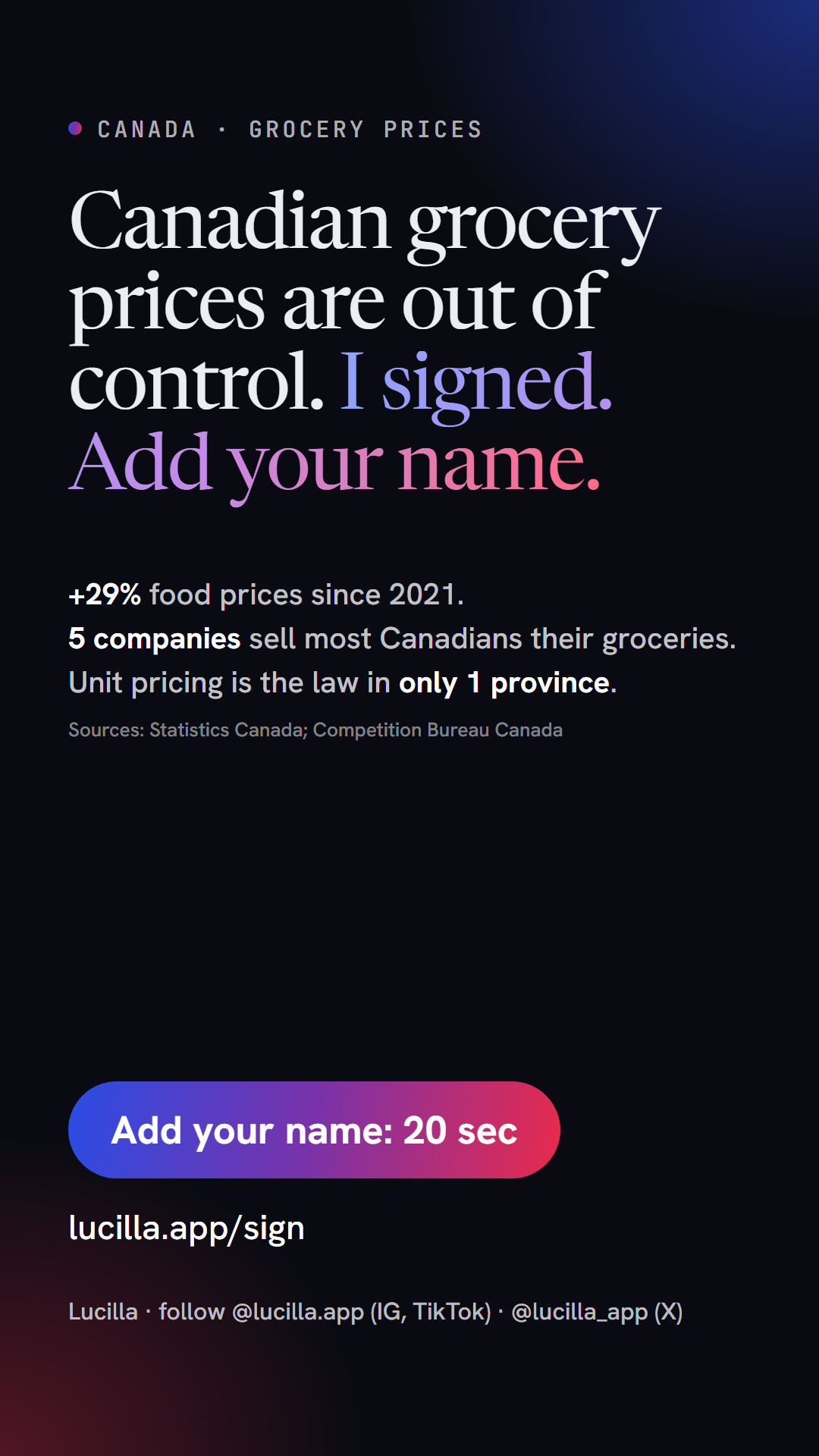
- Share or download the story image.
- Post it to your Instagram Story.
- Add a Link sticker with lucilla.app/sign.
Instagram post
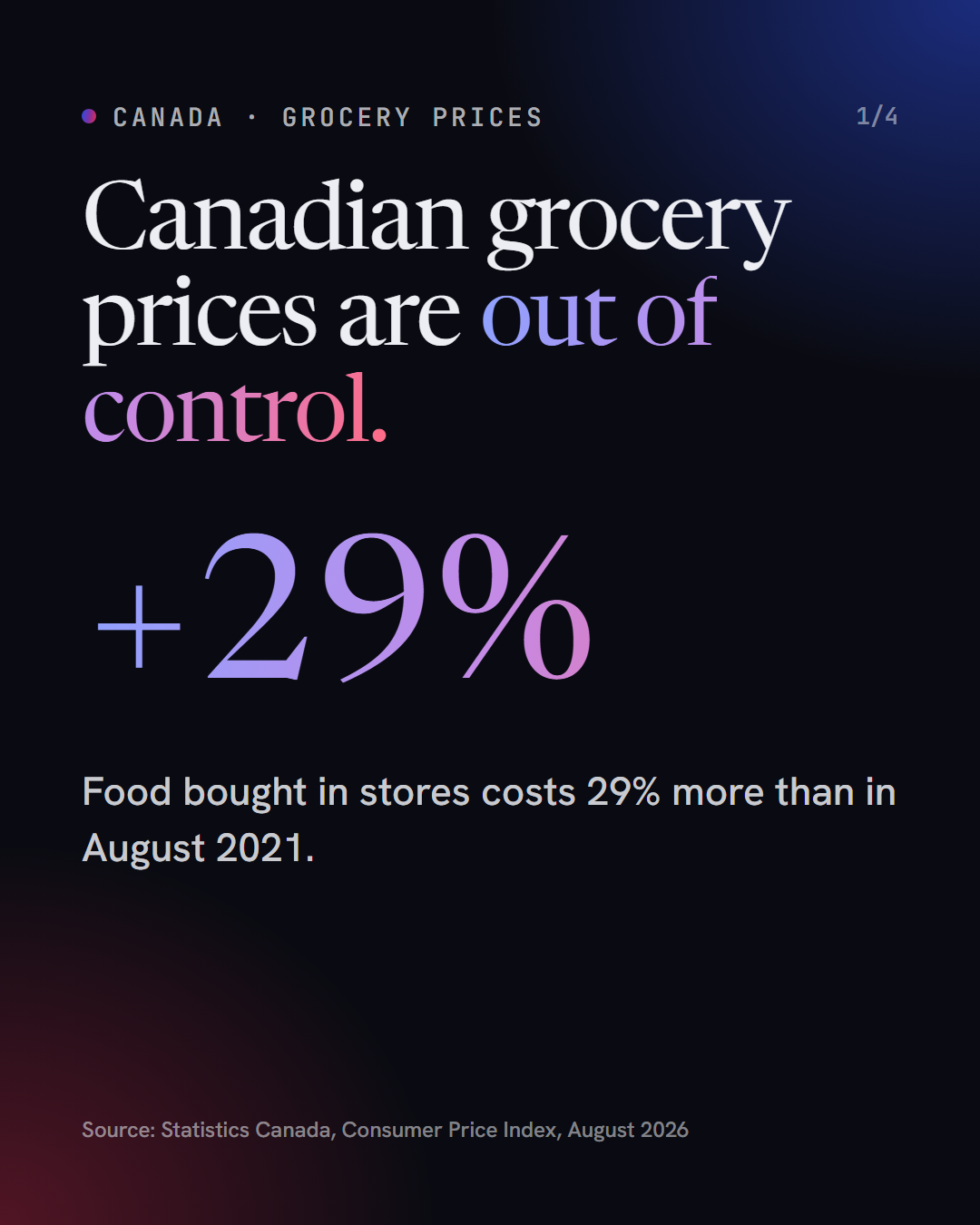
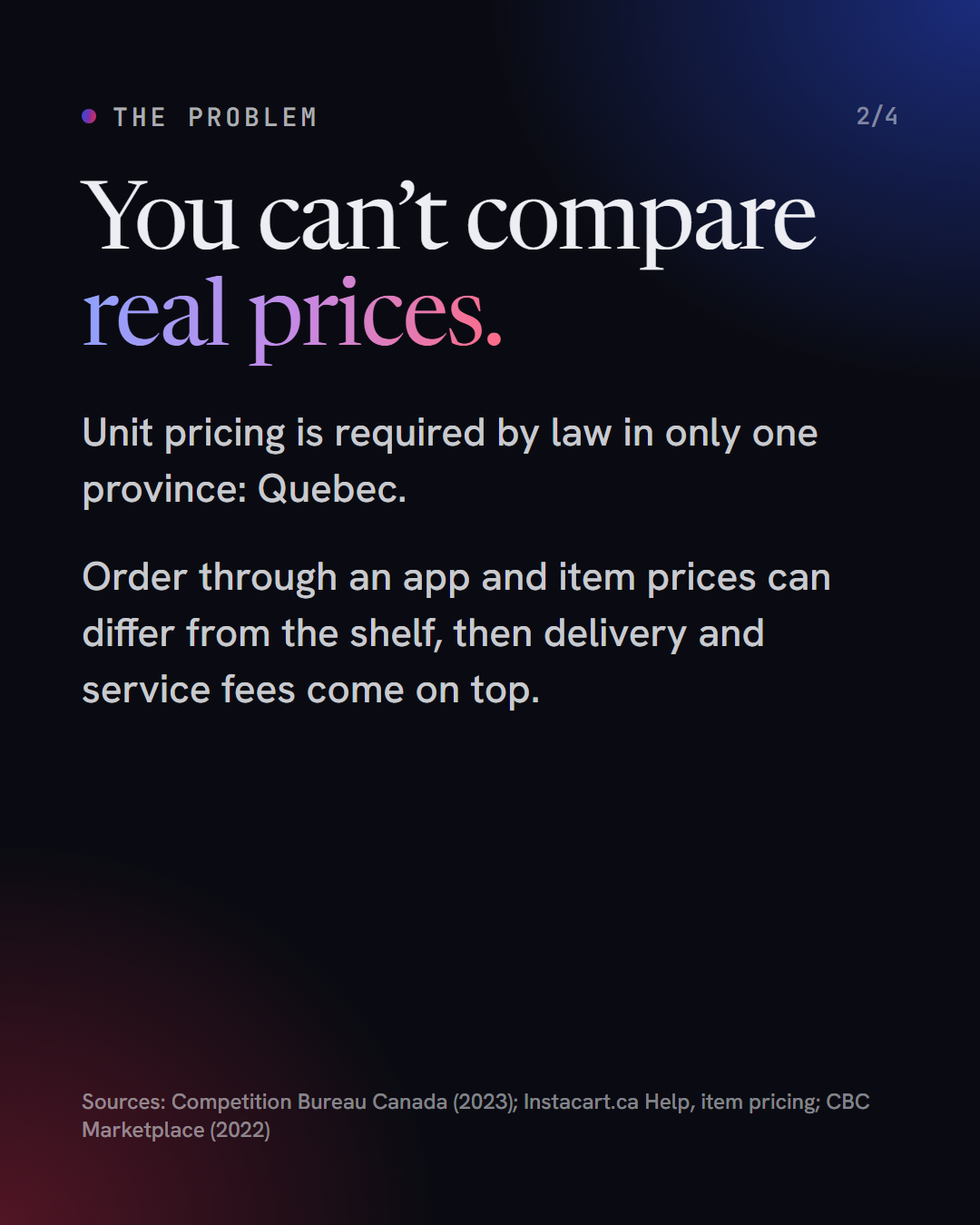
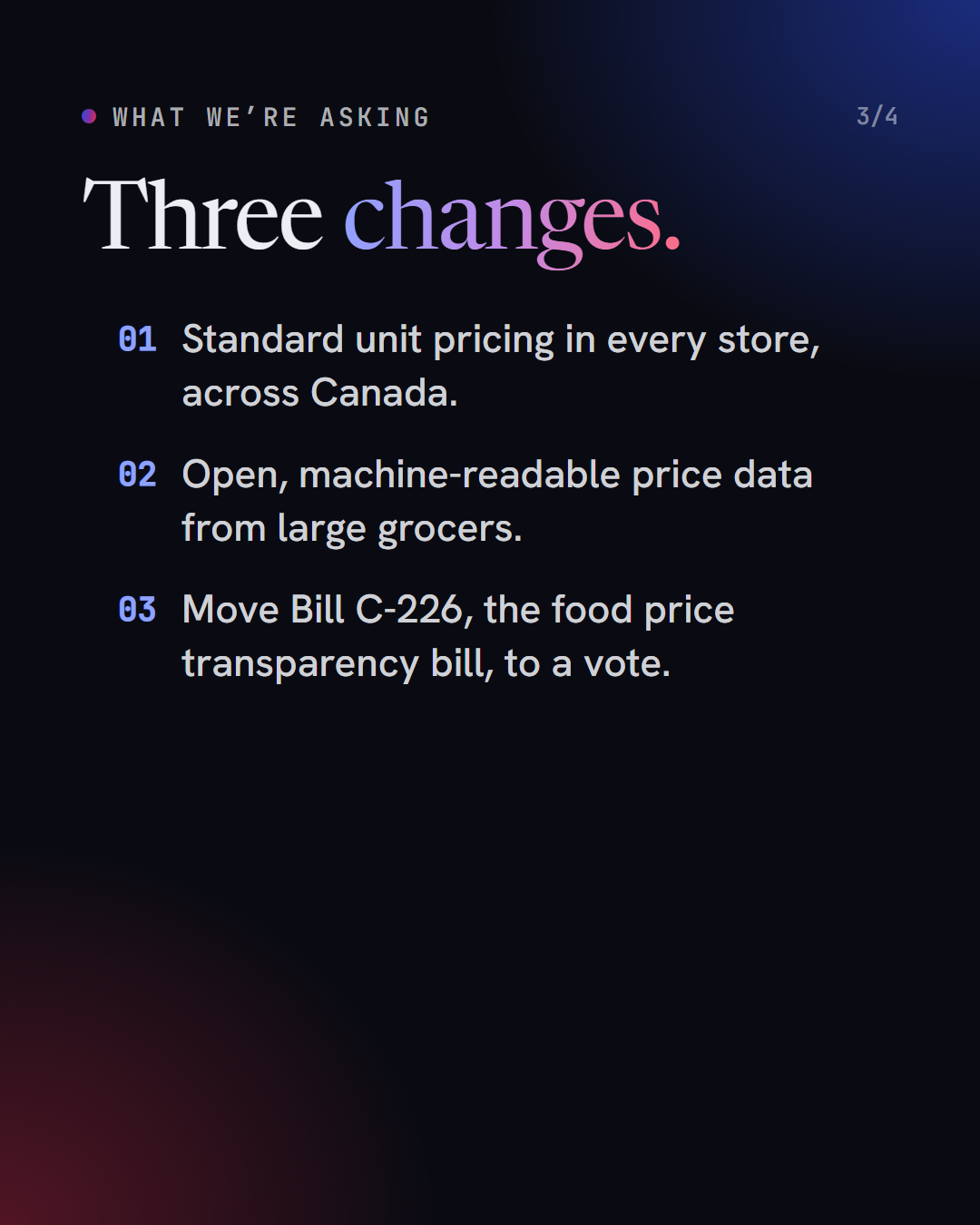
- Share or download the 4 slides.
- Post them as one carousel, in order.
- Paste the Instagram caption below.
TikTok
- Share or download the 4 slides.
- Post them in photo mode as a carousel.
- Paste the TikTok caption and put lucilla.app/sign in your bio.
Write to your MP
Signing counts. A letter from a constituent counts more.
Find your MP
Search by postal code on the House of Commons site. Each MP’s page lists their email and office address.
Find your MP on ourcommons.caSend the letter
Email it, or post it for free: mail to any MP is postage-free at [MP’s name], House of Commons, Ottawa, Ontario K1A 0A6. Source.
Your letter · edit the [brackets]
Dear [Your MP's name],

I am your constituent in [your postal code], and grocery prices are squeezing my household.

Food prices in stores have risen 29% since August 2021 (Statistics Canada, September 2026). The Competition Bureau found in 2023 that most Canadians buy groceries from one of five companies, that the three largest grocers earned more than $3.6 billion in profit in 2022, up 50% from 2019, and that unit pricing is required by law only in Quebec. In the Bureau's words, "It is difficult to compare prices on even a few items between different grocery stores."

I am asking you to act on three things:

1. Mandatory, standardized unit pricing across Canada, so any product can be compared per 100 g or per litre in any store.
2. Open, machine-readable price data from large grocers, so families and independent tools can compare prices between stores.
3. Moving Bill C-226, An Act to establish a national framework to improve food price transparency, forward from committee to a vote.

These transparency rules should also cover prices and fees charged through grocery delivery apps, so shoppers can see what they pay compared with the shelf.

Please tell me where you stand on Bill C-226 and what you will do to make grocery prices transparent.

Sincerely,
[Your name]
[Your address or postal code]
Where things stand
The Grocery Code is not about your prices
The Canada Grocery Code of Conduct has been fully implemented since January 1, 2026, and the major national grocers registered. It governs how grocers deal with suppliers. It does not require prices to be published to shoppers.
MPs have asked for the data before
In 2023 the House Agriculture committee recommended that the government “collect and make public data on costs throughout the Canadian agri-food supply chain,” including food retail.
Quebec already moved
Quebec’s 2024 consumer law sets rules for food price labels, including the regular price beside any sale price and the non-member price beside loyalty prices.
In the United States
Same squeeze, south of the border.
Sign with a ZIP code, and write to your U.S. Representative with the same asks.
Find your Representative7%
The FTC found U.S. food and beverage retailer revenues reached 7% over total costs in the first three quarters of 2023, above the 2015 peak of 5.6%.
The Shrinkflation Prevention Act of 2024 (S.3819) died when that Congress ended.
Haven’t signed yet?
Follow for campaign updates
We post every update here: new signatures, what MPs say back, and the fight for transparent prices.
Sources
- Competition Bureau Canada, Canada Needs More Grocery Competition (June 2023)
- Statistics Canada, The Daily, Consumer Price Index, August 2026
- LEGISinfo, Bill C-226 (45th Parliament, 1st session)
- Office of the Grocery Sector Code of Conduct (January 2026)
- House of Commons AGRI committee, Report 10 (2023)
- Office de la protection du consommateur (Quebec)
- Instacart.ca Help, item pricing
- CBC Marketplace, Instacart pricing (January 7, 2022)
- National Post, Uber Eats grocery order cost (June 26, 2025)
- Consumer Reports, Instacart pricing investigation (December 9, 2025) and follow-up (December 22, 2025)
- U.S. Federal Trade Commission (March 21, 2024)
- GovTrack, S.3819
- House of Commons, Contact us (postage-free mail)
- House of Commons, how e-petitions work
Run by Lucilla, Inc. Not affiliated with any party, grocer or government body. Opinions on this page are ours; facts are linked to their sources. Checked September 30, 2026. MP lookup by postal code uses Represent by Open North.